Why Your Skating Improves the Week You Stop Looking at Your Feet
Quick Answer: Looking down does three things at once, all bad: it drops your head forward and shifts your centre of mass towards your toes, it removes the stable horizon your balance system uses as a reference, and it delays your reaction to surface changes by cutting the distance you can see. Lifting your gaze to about five metres ahead fixes all three simultaneously, which is why it produces such a disproportionate improvement in a single session.
It is the cheapest technique change in skating.
And it is almost never the one beginners are told to make first.

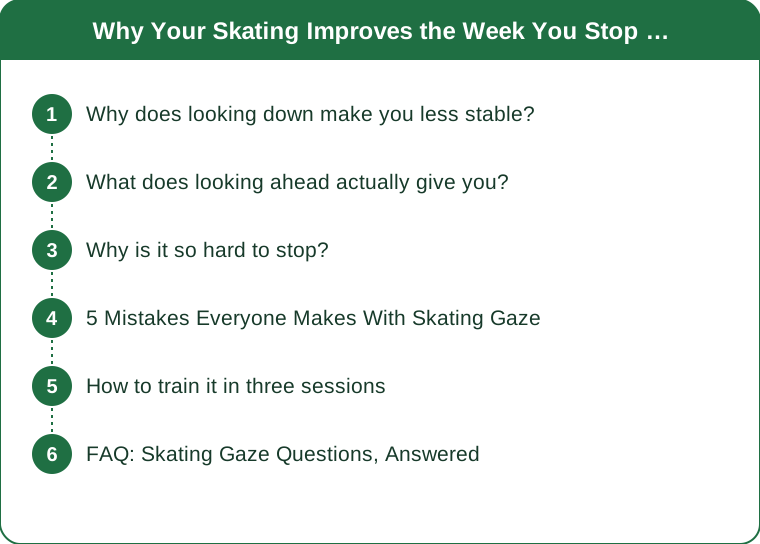
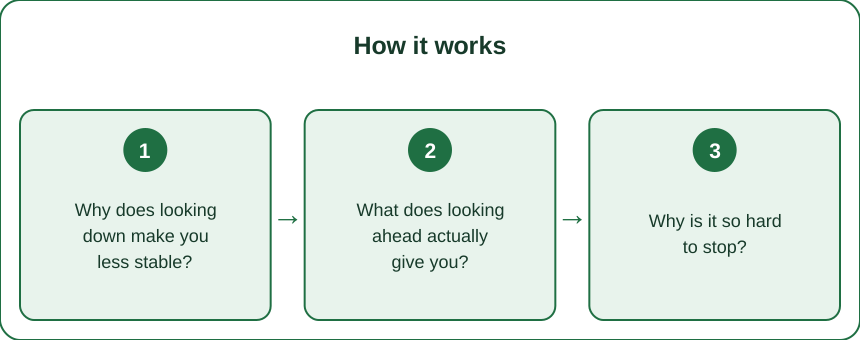
Why does looking down make you less stable?
Start with the mechanical part, because it is the most immediate.
A human head weighs roughly five kilograms. Tipping it forward moves that mass forward and down, and your body compensates by shifting weight towards the toes. On foot this is trivially absorbed. On wheels it is not — toe-heavy weight distribution on skates reduces the control you have over the wheels behind you and makes the classic forward-pitching fall considerably more likely.
Then the sensory part, which matters more.
Balance draws on three streams: the inner ear, sensation from joints and muscles, and vision. Vision contributes a great deal, and specifically it contributes by giving you a stable reference frame — the horizon, the walls, the line of the path.
When you look down, that reference disappears. You are now looking at the ground, which is moving underneath you at speed. Your visual system loses its stable frame and starts reporting motion instead, which the balance system has to reconcile against everything else.
This is precisely the arrangement that makes people feel unsteady, and it is entirely self-inflicted.
There is a related effect that is easy to demonstrate. Try standing on one foot with your eyes fixed on a point on the wall, then try again with your eyes on the floor directly beneath you. The difference is large, and you are not even moving.
What does looking ahead actually give you?
Time, mainly. Which is the resource beginners are shortest on.
At a gentle skating pace of around 10km/h, you cover roughly three metres per second. Looking a metre in front of your skates gives you about a third of a second to respond to whatever appears there — a stone, a crack, a wet patch, a change in surface. That is barely enough time to register it, let alone act.
Looking five metres ahead gives you about a second and a half. The obstacle stops being a surprise and becomes a decision, and a decision made at speed is usually just a small line adjustment rather than an emergency.
The second thing it gives you is direction. You go where you look, on skates as on a bike or in a car. Looking down keeps steering you into the immediate rather than towards where you intend to end up, which is why looking-down skaters tend to wander and make lots of small corrections.
And the third is posture. Eyes up brings the chin up, which brings the chest up, which stacks your weight over the middle of the plate rather than the toe. The whole postural chain follows the gaze, which is why coaches so often fix five things by cueing one.
Why is it so hard to stop?
Because looking down is a reasonable response to a real problem — you genuinely do not know where your feet are yet.
Proprioception, the sense of where your limbs are without looking, is well developed for walking and poorly developed for skating. Skates change the length of your foot, add wheels underneath, and alter every relationship your nervous system has learned. Early on you honestly do not have reliable positional information from below, so you go looking for it visually.
The uncomfortable truth is that looking down slows the development of the sense that would let you stop looking down. Proprioception improves through use under uncertainty. Substituting vision for it removes the demand that drives the adaptation.
So it is a genuine trap: the strategy that makes the first hour feel safer makes the fifth hour take longer to arrive.
The way out is not willpower, it is scaffolding. Give yourself an environment where looking ahead is low-risk — a smooth, empty, flat surface with no obstacles worth checking for — and the gaze can come up without demanding courage. Trying to fix your gaze on a crowded, cracked path is asking for a change that the environment is actively punishing.
And there is a seasonal wrinkle. As paths start collecting leaves and damp patches, the temptation to look down rises sharply, exactly when longer sightlines are most valuable. Autumn skating rewards looking further ahead, not closer.

5 Mistakes Everyone Makes With Skating Gaze
1. Fixing on one spot instead of scanning. The goal is a soft, moving gaze that takes in the middle distance and periodically checks further out. Staring rigidly at a point five metres ahead is its own problem — it removes peripheral awareness and makes you late to anything approaching from the sides.
2. Looking at other skaters instead of the space. You go where you look, so looking at the person you are worried about colliding with is a reliable way to move towards them. Look at the gap you intend to pass through.
3. Dropping the gaze the instant something feels wobbly. This is the reflex, and it is backwards — the wobble is often caused by looking down and gets worse when you look down again. The corrective habit is to lift the gaze when you feel unstable, which takes deliberate practice because it contradicts instinct.
4. Practising gaze on a surface that punishes it. A rough or busy path makes looking down genuinely rational. Build the habit somewhere smooth and empty, then transfer it.
5. Assuming it is a confidence problem. It is not, and treating it as one wastes months — it is a proprioception gap, and the fix is skill-building drills that force your feet to report their own position, not encouragement or trying harder.
How to train it in three sessions
A concrete progression. Each of these takes about fifteen minutes on a smooth, empty, flat surface.
Session one — static. Standing still in skates, feet shoulder-width, eyes on a fixed point at eye level about five metres away. Shift weight side to side, then forward and back, without looking down. Then lift one foot briefly. The aim is simply to accumulate time balancing without visual input from below.
Session two — rolling with a target. Choose an object about twenty metres away and skate towards it, eyes on it the whole way. Stop, choose a new target, repeat. Ten times. Do not look for your feet even once — this is why the surface needs to be clear, so that not looking is genuinely safe.
Session three — scanning. Same as session two, but now practise moving your gaze deliberately: far, middle, far, middle. Add a second person or a cone to skate around so the gaze has a real job. This builds the scanning pattern rather than a fixed stare.
Then the transfer step, which is where most people lose it: on your next normal skate, pick one stretch of path and hold the gaze there only. Not the whole session. One stretch, then release. Habits transfer better in small deliberate blocks than in whole-session resolutions.
A useful check throughout: if you can describe what was happening thirty metres ahead of you during your last skate, your gaze was up. If you cannot, it was not, regardless of what it felt like.
Wear your protective gear for all of this. Practising a change in visual habit is exactly when a fall becomes more likely, and the whole point of pads is to make the learning cheap.
FAQ: Skating Gaze Questions, Answered
How far ahead should I actually be looking?
About five metres at gentle speeds, further as you speed up. A reasonable rule is roughly one and a half to two seconds of travel ahead — which naturally extends as you go faster, which is exactly what you want.
Is it different for outdoor and indoor skating?
The principle is identical, the practice differs. Indoors, surfaces are predictable so the gaze can stay further out and focus on traffic. Outdoors you need a scanning pattern that alternates between near surface checks and the middle distance — but the near check is a glance, not a resting position.
What if the surface genuinely is unpredictable?
Then slow down rather than looking down. Reducing speed shortens the distance you need to see and restores your reaction time, which is what you were trying to buy by looking down anyway — except slowing down does it without costing you balance.
Does this apply to inline skating too?
Yes, identically. The mechanics of gaze, balance and reaction time do not care about the wheel arrangement. It also transfers directly to ice skating, cycling and skiing.
I still look down and I have skated for years. Does it matter?
If you are stable and comfortable, it matters less than for a beginner — you have built the proprioception the hard way. It still costs you reaction time, so it is worth changing for outdoor skating specifically. Fifteen minutes of the drill above is usually enough to notice the difference.
TL;DR:
- Looking down shifts weight to the toes, removes your stable visual reference, and cuts reaction time
- At skating speed, looking one metre ahead gives you a third of a second; five metres gives you a second and a half
- You go where you look, so a downward gaze produces wandering and constant small corrections
- Looking down is a proprioception gap, not a confidence problem — and it slows the development of the sense that would fix it
- Build the habit on smooth empty surfaces first, then transfer it one stretch of path at a time
Next time out, pick an object twenty metres away and skate to it without once checking your feet. Most people feel the difference inside a single length of path — and it costs nothing but the decision to try it.
Keep Reading
This article is for general informational and styling purposes only. Fit, sizing, and product availability may vary.