Why Autumn Leaves Are More Dangerous Than Rain for Skating
Quick Answer: Wet ground reduces grip everywhere by a predictable amount, so you can adjust once and skate the whole session that way. Leaves remove grip completely in unpredictable patches, and a dry leaf on dry pavement is slipperier than wet concrete. The fix is scanning further ahead and shifting your weight back over both feet, not skating slower.
You already know to be careful in the rain. Everyone does.
Then you roll over a single dry leaf on a clear October afternoon and your foot goes out from under you at half the speed you handle wet ground at.
Rain is a condition. Leaves are an ambush, and they need a completely different approach.

What makes a dry leaf worse than wet pavement?
Two things: how much grip disappears, and how much warning you get.
Wet pavement typically drops your available grip by something like a third. It is a big change, but it is uniform - every part of the path is equally reduced, you feel it within the first few strokes, and you adjust your whole session accordingly.
A leaf is different. A dried leaf sitting on smooth pavement acts as a loose interface between your wheel and the ground. Grip does not drop by a third; for the fraction of a second the wheel is on it, it drops to almost nothing. The leaf slides on the pavement and your wheel slides on the leaf.
And crucially, you get no warning. The surrounding ground grips perfectly. Your body is loaded for a grippy surface, your weight is committed to an edge, and then one wheel loses everything while the other three keep working.
That asymmetry is what causes falls. A uniform loss of grip makes you slide; a single-wheel loss of grip rotates you.
Where do the dangerous leaves actually collect?
Not in the middle of the path, which is where most people are watching.
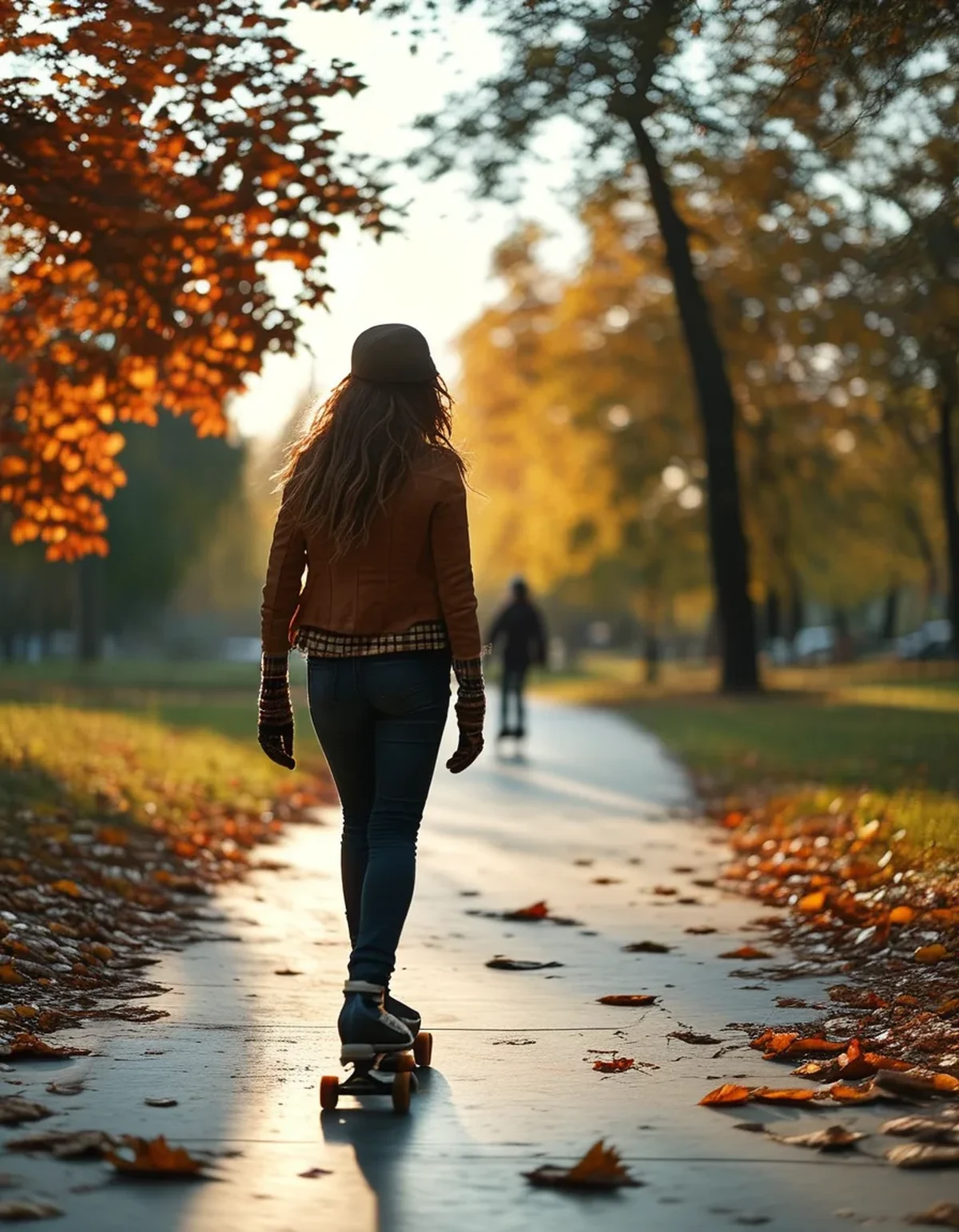
Leaves gather where the air slows down and where water sits. In practice that means the inside of curves, the edges of the path where the camber falls away, the lee side of walls and hedges, and the flat patch at the bottom of any slope.
That list should worry you, because it is almost exactly the list of places where you are already committed to an edge or carrying speed you cannot dump quickly.
A few more specific hazards worth knowing:
- A single leaf on clean pavement is more dangerous than a thick carpet of them, because a carpet is visible from distance and you slow down for it. One leaf you do not register at all.
- Damp leaves that have been walked on turn into a dark film that looks like a wet patch and behaves like grease. This is the worst surface on the list.
- Leaves over a drain grate or a paint line stack two low-grip surfaces on top of each other.
- Piles at the edge of the path hide what is under them - kerbs, roots, and cracks all disappear under three inches of leaf.
How do you change your technique for it?
Skating slower is the instinct and it is only half right. Speed helps you less than position does, because a slip at low speed still rotates you if your weight is on one edge.
Widen your stance and centre your weight. The single most protective change is skating with your weight distributed across both feet rather than rolling from edge to edge. If both feet are loaded, one wheel losing grip is a wobble instead of a fall.
Scan four to five seconds ahead, not two. In summer you can look at the ground just in front of you and react. Leaves require you to plan the line before you get there, because there is no reacting to a leaf you are already on.
Straighten before the leaves, not on them. If you can see a leaf patch on a curve, take the turning out early, cross the patch in a straight line with both feet, and resume the turn after. A wheel that is rolling straight and unloaded can slide a little and recover; a wheel on an edge cannot.
Stop pushing while you cross. No stroke, no stopping, no direction change. Glide across on both feet and do everything else on either side of it.
Keep your hands out of your pockets. This sounds trivial and is not - cold weather puts hands in pockets, and hands in pockets converts a recoverable stumble into a fall you cannot brace for.
Myth vs Fact: Autumn Skating Conditions
Myth: Softer wheels solve it. Fact: Softer wheels help genuinely on rough and damp pavement, because they conform to texture. They do very little on a leaf, because the problem is a loose object between two surfaces rather than a lack of conformity. Buy them for the season, but do not treat them as protection.
Myth: The leaves are only a problem when it is wet. Fact: Dry leaves on dry pavement are one of the lowest-grip combinations you will meet outdoors. Dampness makes the film worse, but dry is already bad.
Myth: You can feel a leaf before you slip on it. Fact: You cannot. A leaf is thin and light enough that there is no feedback through the wheel before grip goes. Your eyes are the only warning system available.
Myth: It is safer to skate in the road where the leaves get swept. Fact: Trading a grip hazard for a traffic hazard is not a trade. Roads clear faster because of traffic, but that is the same traffic you would be sharing space with.
FAQ: Autumn Outdoor Skating Questions, Answered
Should I switch wheels for autumn?
Going a little softer helps with cold, damp, and rougher pavement, all of which arrive together. Something in the 78A to 82A range is a reasonable outdoor autumn choice, but treat it as comfort and rough-surface grip rather than leaf insurance.
Is there a time of day that is better?
Mid-afternoon. Morning paths hold dew and overnight leaf fall; evening brings damp back and poor light exactly when the leaf colors blend into the pavement. Early afternoon is usually the driest and best lit.
What about wrist guards - do I need them more now?
Yes, and this is the season most people first fall in months. Autumn falls tend to be sudden and rotational rather than slow slides, which is exactly the type wrist guards and knee pads are built for.
TL;DR:
- Wet ground reduces grip predictably everywhere; a leaf removes it completely in one unpredictable spot.
- Leaves collect on the inside of curves, at path edges, and at the bottom of slopes - the same places you are already committed.
- Skate across patches straight, on both feet, with no push, turn, or stop until you are clear.
- Scan several seconds ahead, keep your hands out of your pockets, and treat one leaf as more dangerous than a whole carpet.
Autumn is genuinely good skating weather - cool air, quiet paths, and the best light of the year. It just asks you to move your attention from your feet to the fifteen feet in front of them.
Keep Reading
This article is for general informational and styling purposes only. Fit, sizing, and product availability may vary.