Why Your Skates Feel Slower After They Have Been Sitting in the Car
Quick Answer: Cold thickens the lubricant in your bearings and stiffens the polyurethane in your wheels, both of which increase rolling resistance. A skate that has been sitting in a cold car overnight is genuinely slower for the first several minutes until friction warms the bearings and the wheels flex back to their normal durometer. Skate for five minutes before judging anything. The equipment is fine; it is cold.
Most autumn skate complaints are temperature, not maintenance.
Here is how to tell the difference.

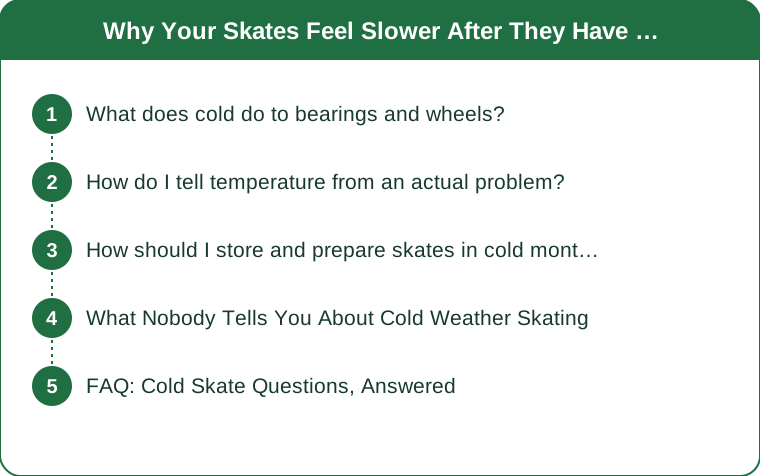
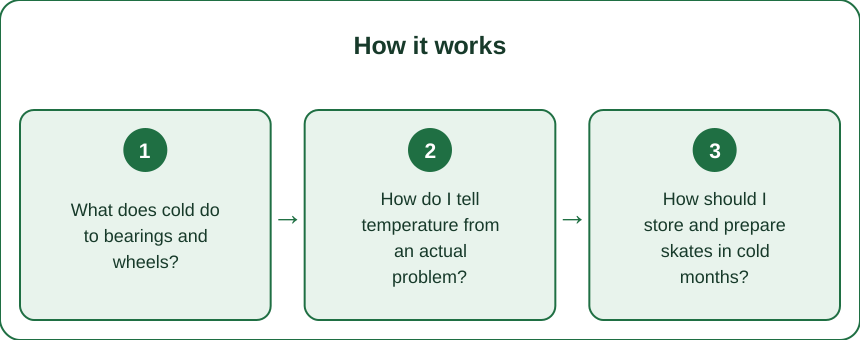
What does cold do to bearings and wheels?
Both get stiffer, in different ways, and the effects add up.
Bearing lubricant thickens as temperature falls. Grease and oil become considerably more viscous in cold conditions, and thicker lubricant means more resistance to rotation. This is the single largest factor in the first few minutes.
Grease-packed bearings are affected more than oil-lubricated ones. Grease is thicker to begin with and stiffens more dramatically, which is why skaters in cold climates often prefer lighter oil.
Wheel polyurethane hardens in the cold. Durometer is temperature-dependent - a wheel rated 78A at room temperature behaves harder in cold air. A harder wheel grips less and transmits more vibration, and on cold pavement that reads as skating on glue.
The road surface is colder and harder too. Cold asphalt is stiffer and gives less, which changes the interaction further. Combined with a harder wheel, you get less grip and more chatter.
And condensation is a real risk. Bringing cold skates into a warm room causes moisture to condense on and inside the bearings, and repeated cycles of that lead to rust - which is a genuine maintenance problem rather than a temporary one.
The temporary effects resolve with a few minutes of skating. Friction warms the bearings quickly, and the wheels warm from contact and flexing.
How do I tell temperature from an actual problem?
Four checks, all fast.
Spin test each wheel off the ground. A wheel should spin freely for several seconds. Do this cold and then again after ten minutes of skating - if the spin time improves substantially, it was temperature.
Listen. A grinding, crunching, or gritty sound is dirt or rust, not cold. Cold bearings are quiet and merely slow.
Check for side-to-side play. A wheel that wobbles on the axle has a bearing problem or a loose axle nut, which is a mechanical issue at any temperature.
Look at the wheel wear. Uneven or coned wear changes how the skate rolls and is unrelated to weather. Rotate wheels regularly - this is the maintenance most people skip.
And check the axle nut tightness. Over-tightened axle nuts compress the bearings and dramatically increase resistance - a very common cause of slow skates that gets blamed on bearings. The wheel should spin freely with a tiny amount of lateral play.
The pattern: temperature effects improve as you skate; mechanical problems do not. Ten minutes of skating is the diagnostic.

How should I store and prepare skates in cold months?
Five habits that prevent most autumn and winter problems.
Do not store skates in the car. Repeated cold-warm cycling causes condensation inside the bearings, which is the main route to rust. Bring them inside.
Let them reach room temperature before skating if you can. Twenty minutes indoors makes a noticeable difference to the first few minutes on the ground.
Dry them thoroughly after skating on damp ground. Autumn means wet leaves and damp pavement, and water in bearings is the fastest way to ruin them. Wipe the wheels and bearing faces after every wet session.
Consider a lighter lubricant for cold months. Thin bearing oil performs better in cold than heavy grease, at the cost of needing more frequent reapplication. This is a genuine seasonal adjustment that experienced skaters make.
Skate softer wheels in the cold. A wheel a few points softer on the durometer scale compensates for cold hardening and restores grip on cold pavement. Many outdoor skaters keep a cold-weather wheel set for exactly this.
And warm up longer yourself, not just the skates. Cold ankles and calves are stiffer, and ankle stability is what everything else depends on. Five minutes of easy rolling before anything technical is not optional in October.
What Nobody Tells You About Cold Weather Skating
Falls hurt more and happen more. Cold pavement is less forgiving, cold muscles react slower, and stiffer wheels grip less - three effects pointing the same direction. Pads that felt optional in August are not in October.
Wet leaves are the most underestimated hazard in outdoor skating. A layer of damp leaves on pavement has almost no traction, and it hides surface changes underneath. This is the autumn-specific risk that catches experienced skaters.
Your toe stop hardens too. Rubber toe stops become less grippy in the cold, which changes stopping distance measurably. Practise stopping early in a session, not when you need it.
Bearings that got wet last week will feel bad this week. Rust develops within days, and the slow, gritty feel that appears after a wet session is corrosion, not cold. Clean and re-lubricate rather than waiting for it to improve.
Cold hands make everything harder. Adjusting laces, tightening trucks, and catching yourself in a fall all require hands that work. Gloves are protective equipment in cold weather, not just comfort.
And daylight is the constraint nobody plans for. Outdoor skating time shrinks fast through autumn, and skating in low light with cold-stiffened wheels on leaf-covered pavement is a different activity from a summer evening session. Move sessions earlier rather than pushing into dusk.
FAQ: Cold Skate Questions, Answered
Should I clean my bearings more often in autumn?
Yes, if you skate on damp ground. Water and grit are what destroy bearings, and autumn provides both. Wiping them down after every wet session and a full clean every month or two is reasonable for regular outdoor skating.
Are softer wheels really worth swapping for?
For regular outdoor skating in cold weather, many skaters find it a meaningful difference. A few points softer restores the grip that cold takes away, and outdoor wheels are relatively inexpensive. If you skate occasionally, warming up longer is enough.
How cold is too cold to skate outdoors?
There is no hard number, but grip and reaction time both degrade as it drops, and any frost or damp on the surface changes the calculation entirely. Frost, ice, and wet leaves are the actual limits, not the thermometer - if the surface is damp and near freezing, it is an indoor day.
TL;DR:
- Cold thickens bearing lubricant and hardens wheel polyurethane - both increase rolling resistance.
- The effect resolves after several minutes of skating - if it does not, the problem is mechanical.
- Check axle nut tightness first - over-tightening is a very common cause of slow-feeling skates.
- Do not store skates in the car - condensation cycles are how bearings rust.
- Wet leaves and cold toe stops are the two autumn hazards worth respecting.
Spin-test your wheels before and after ten minutes of skating this weekend. That comparison tells you whether it is the weather or the bearings.
Keep Reading
This article is for general informational and styling purposes only. Fit, sizing, and product availability may vary.