Why Your Skates Feel Completely Different Once the Pavement Cools Down
Quick Answer: Skate wheels are made of urethane, which stiffens as it gets colder. A wheel that felt grippy and cushioned at 85 degrees becomes noticeably harder and slidier at 55, so you get less grip, more vibration, and a slower roll on cold rough pavement. Your skates are the same; the material properties changed.
You skate the same path you have skated all summer. The first cool morning, everything feels off — the skates chatter over surfaces that felt smooth in July, turns break loose earlier, and you feel every crack in the pavement.

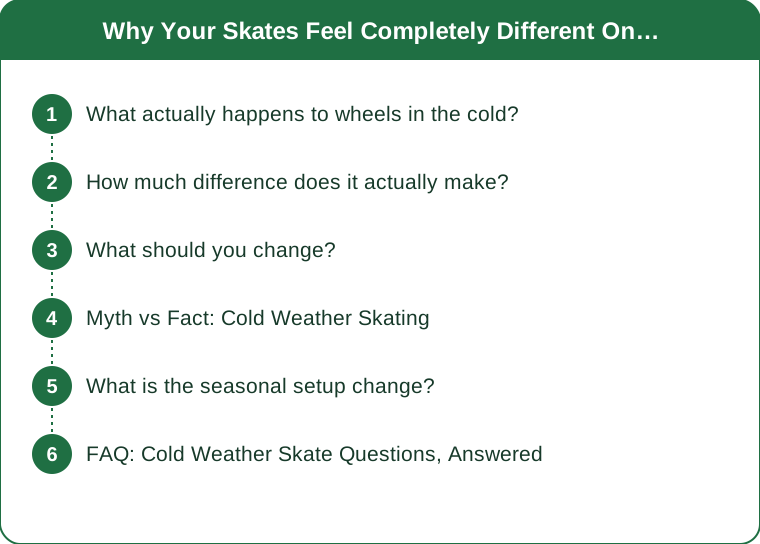
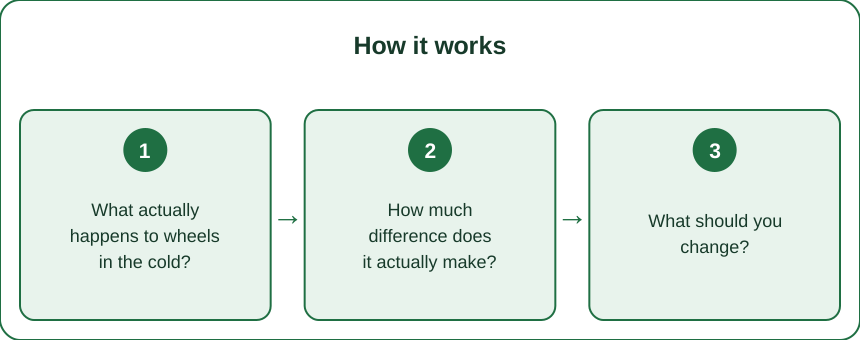
What actually happens to wheels in the cold?
The urethane stiffens, and every property you care about follows from that.
Urethane is a polymer, and polymers get harder as temperature drops. A wheel rated at a given durometer at room temperature behaves like a harder wheel at 50 degrees. The rating on the wheel is a room-temperature specification, not a constant.
What harder means in practice:
Less grip. Grip comes from the wheel deforming slightly to conform to the surface. A stiffer wheel deforms less, so it makes less contact and slides earlier in a turn.
More vibration. Softer wheels absorb small surface irregularities. Stiffer ones transmit them to your feet, which is why rough pavement suddenly feels much rougher.
Different roll. Counterintuitively, cold wheels often feel slower on rough surfaces despite being harder, because the vibration losses on a rough surface outweigh the reduced deformation losses. On smooth surfaces they can roll faster.
Bearings change too — grease becomes more viscous when cold, which adds noticeable drag for the first few minutes until they warm up from use.
How much difference does it actually make?
Enough that experienced skaters change wheels seasonally.
The effective hardness shift across a summer-to-autumn temperature change is comparable to moving one step up the durometer scale. That is the same magnitude as deliberately buying harder wheels, which nobody would expect to be unnoticeable.
The practical markers:
- Turns that were comfortable now break traction earlier
- Stopping distance increases, particularly on a plow or T-stop
- Surfaces you considered fine now feel rough enough to be distracting
- Painted lines, manhole covers, and damp patches become considerably more slippery than they were
That last one compounds with autumn conditions generally. Wet leaves, morning dew, and damp pavement combine with reduced grip to produce a surface that is genuinely much less predictable than the same path in August.
This is a safety consideration rather than just a performance one. The gap between what your skates did in July and what they do in October is large enough that skating at your summer confidence level on a cold damp morning is how people fall.
What should you change?
A few adjustments, in order of how much they help.
Switch to softer wheels for the season. If you skate outdoors regularly, a lower durometer wheel restores the grip and cushioning you lost. This is the direct fix and it is what the material change calls for.
Warm up gradually and skate the first ten minutes conservatively. Wheels and bearings both warm from use, and the first several minutes are the worst conditions of the session. Most cold-weather falls happen early.
Store your skates indoors. Skates that have been in a car or garage overnight start much colder than ambient and take considerably longer to come up. This is the free fix and the one people most often skip.
Adjust your expectations for the surface. Wet leaves are genuinely slippery, and they hide surface defects underneath. Autumn paths need to be read differently.
Check your toe stops. Rubber toe stops harden in the cold too, which means less grip when you stop. Worn toe stops that were marginal in summer become genuinely unreliable in cold weather.
And wear the protective gear, which matters more when grip is less predictable. Wrist guards in particular — wrist injuries are the most common skating injury and the most preventable.

Myth vs Fact: Cold Weather Skating
Myth: Wheel durometer is a fixed property. Fact: It is a room-temperature specification. The same wheel is measurably harder at 50 degrees than at 85, which is why the rating on the package is only useful as a comparison between wheels at the same temperature.
Myth: Harder wheels are always faster. Fact: On smooth surfaces, generally yes. On rough surfaces, softer wheels are often faster because they absorb vibration that would otherwise be lost energy. Outdoor autumn skating on typical pavement is exactly the case where softer wins.
Myth: You just need to warm the wheels up and it is fine. Fact: Wheels do warm from use and they will not reach summer temperatures on a cold day. You get some of the property back, not all of it. The setup change is still worth making.
Myth: Indoor skating is unaffected. Fact: Mostly true — a heated rink is a stable environment. What does change is that skates brought in from a cold car take fifteen to twenty minutes to reach rink temperature, and the first few laps feel different.
Myth: This only matters if you skate fast. Fact: Grip matters most in turns and stops, which everyone does at every speed. Slower skating on reduced-grip wheels on damp autumn pavement still produces falls.
What is the seasonal setup change?
A short checklist for the transition.
- Softer wheels, ideally a set you keep specifically for cooler months. Swapping wheels takes about fifteen minutes and is worth it if you skate weekly
- Fresh or cleaned bearings, since cold thickens the lubricant and dirty bearings compound the problem. A lighter-weight lubricant is worth considering if you skate through winter
- Check toe stops and brakes for wear, and replace them earlier than you would in summer
- Store skates indoors, always
- Full protective gear, particularly wrist guards, and this is the season to be strict about it
- Layer for the stop, not the skate. You warm up quickly while moving and cool down fast when you stop, and standing around in sweaty clothing on a cold day is how sessions end early
And the thing that makes autumn skating worth the adjustments: the paths are emptier, the air is better for sustained effort, and the surfaces are dry more reliably than in spring. With softer wheels and a conservative first ten minutes, autumn is genuinely one of the better outdoor skating seasons — it just does not work with a summer setup.
One practical note on timing: the window before the pavement gets genuinely cold and wet is short. Late August through October in most of the US is the good part, and it is worth making the wheel swap now rather than after a session that goes badly.
FAQ: Cold Weather Skate Questions, Answered
What durometer should I switch to?
If you are on something around 85A to 88A for summer outdoor skating, dropping to roughly 78A to 82A for cooler weather restores a similar feel. The specific numbers depend on your weight and the surfaces you skate, so treat it as a starting point and adjust from how the wheels behave on your usual route.
Can I skate on damp pavement at all?
With caution and reduced expectations. Damp pavement substantially reduces grip, wet leaves are much worse than the pavement itself, and water in bearings causes rust. If it is genuinely wet, it is a session worth skipping. Light morning dampness is manageable at a conservative pace with softer wheels.
Do I need different skates for winter, or just wheels?
Just wheels and bearing maintenance for most people. The boot itself is unaffected by temperature in any meaningful way, though a thicker sock changes the fit — check that your skates are not too tight with winter socks, since a compressed foot in a cold boot gets uncomfortable fast.
TL;DR:
- Urethane stiffens as it cools, so the same wheel behaves roughly a durometer step harder in autumn
- You lose grip and gain vibration, and stopping distances increase noticeably
- Switch to softer wheels, store skates indoors, and skate the first ten minutes conservatively
- Wet leaves plus reduced grip is the genuinely risky combination — wrist guards matter more this season
The skates did not change. The material they are made of behaves differently at 55 degrees than at 85, and swapping to softer wheels gets you back the session you had all summer.
Keep Reading
This article is for general informational and styling purposes only. Fit, sizing, and product availability may vary.