Why Your Bearings, Not Your Wheels, Decide How Fast You Roll
Quick Answer: Wheels control grip, cushioning and how the surface feels. Bearings control how long a roll lasts once you stop pushing. If your skates feel slow and sticky despite good wheels, the bearings are almost certainly dirty, wet or over-tightened at the axle nut. Cleaning and re-lubricating bearings costs almost nothing and restores more speed than any wheel upgrade — and it should happen every 20 to 40 hours of skating, or immediately after any wet or dusty session.
New wheels, same sluggish feeling.
You push, you slow down almost immediately.
That is not the wheels. It never was.

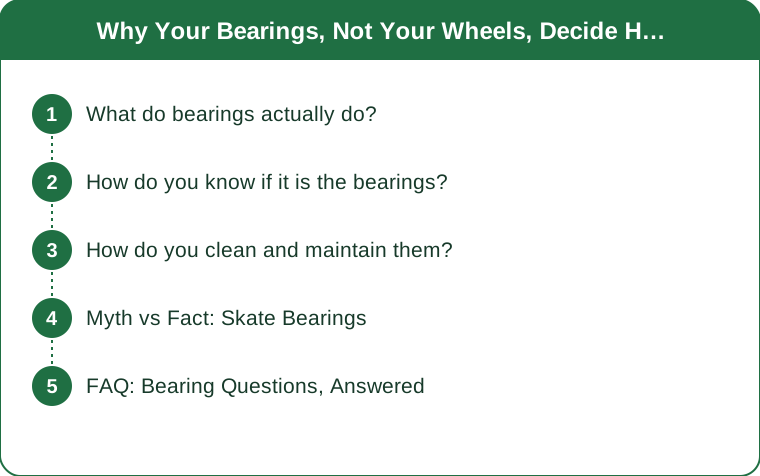
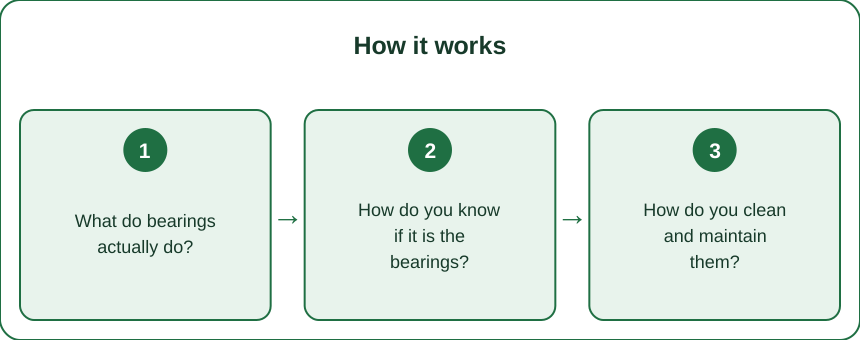
What do bearings actually do?
They decide how much of your push survives.
Each wheel has two bearings that let it spin freely on the axle. Everything about how long a roll lasts happens inside them.
Friction inside the bearing is what stops you. Dirt, moisture, degraded lubricant and damaged races all add friction, and the effect is cumulative and gradual — which is why people do not notice their skates slowing down.
Wheels affect roll differently. Harder wheels roll faster on smooth surfaces because they deform less. Softer wheels grip better and absorb rough ground. Neither addresses the roll efficiency that bearings control.
ABEC ratings are widely misunderstood. The rating describes manufacturing tolerances, not speed or quality for skating. A clean ABEC-5 bearing outrolls a filthy ABEC-9 every time.
The axle nut matters more than the bearing grade. Overtightening clamps the bearings and kills the roll instantly. This is the single most common cause of ‘my new bearings feel slow’.
Spacers matter too. Missing or wrong-sized spacers let the axle nut compress the bearings even when it feels correctly tightened.
How do you know if it is the bearings?
Four checks, none of which needs a tool.
The spin test. Lift the skate, spin each wheel by hand, and count how long it turns. A healthy bearing spins freely for several seconds. One that stops abruptly is dirty, dry or damaged.
Compare wheel to wheel. One wheel stopping much faster than the others isolates the problem immediately.
Listen. Healthy bearings are quiet. Grinding, crunching or a rhythmic tick means dirt or damage inside.
Loosen the axle nut and re-test. If the spin improves noticeably, you were overtightened — and this is common enough to check first.
Feel for side-to-side wheel play. A little is normal. A lot means the nut is too loose or a spacer is missing.
And the honest check: if you cannot remember ever cleaning them, that is the answer. Bearings are the most neglected component on any pair of skates.

How do you clean and maintain them?
A straightforward routine that takes about half an hour.
Remove the wheels and push the bearings out, using the axle as a lever or a bearing puller.
Remove the shields carefully. Rubber shields prise off with a pin; metal ones are usually not designed to be removed.
Soak in a degreaser or solvent and agitate. Isopropyl alcohol or a citrus degreaser both work. Do not use water.
Dry completely. This is the step people rush and it matters most — any residual moisture causes rust inside the race. Air dry fully or use compressed air.
Lubricate lightly. Two or three drops of bearing oil per bearing, or a small amount of bearing grease. More is not better: excess lubricant attracts dirt and slows the roll.
Reassemble with the spacers in place, and tighten the axle nut until the wheel spins freely with minimal side-to-side play — then stop.
Frequency: every 20 to 40 hours of skating, and immediately after any session in wet or dusty conditions.
Seasonal note: autumn is the season that kills bearings. Damp pavements, wet leaves and road grit all get inside, and moisture plus grit produces rust and pitting within weeks. A skate through a puddle should be followed by cleaning and re-oiling the same evening — not next month.
Myth vs Fact: Skate Bearings
Myth: higher ABEC means faster. Fact: ABEC measures manufacturing tolerance, not skating performance. Cleanliness and lubrication matter far more.
Myth: more lubricant is better. Fact: excess oil attracts dirt and increases drag. Two or three drops is the correct amount.
Myth: you can wash bearings in water. Fact: water causes rust inside the race, which is unrecoverable. Use a solvent and dry completely.
Myth: sealed bearings need no maintenance. Fact: sealed bearings resist contamination better and still degrade. They need cleaning less often, not never.
Myth: new bearings will fix a slow skate. Fact: if the axle nut is overtightened or a spacer is missing, new bearings will feel exactly as slow as the old ones.
Myth: bearings are what make you fast. Fact: technique and push mechanics dominate. Bearings decide how much of each push you keep, which is meaningful but secondary to how you skate.
FAQ: Bearing Questions, Answered
How often should I clean my bearings?
Every 20 to 40 hours of skating, and immediately after any wet or dusty session.
What should I use to clean them?
Isopropyl alcohol or a citrus degreaser, followed by complete drying and light re-oiling. Never water.
How much lubricant?
Two or three drops of bearing oil per bearing. Excess attracts dirt.
How tight should the axle nut be?
Tight enough that the wheel spins freely with only minimal side-to-side play. Overtightening is the most common cause of a slow roll.
Do I need expensive bearings?
No. A clean mid-range bearing outperforms a neglected premium one comfortably.
How do I know a bearing is beyond saving?
Visible rust, a gritty feel that persists after cleaning, or a grinding noise. Replace those individually or as a set.
Do wheels matter at all for speed?
Yes — harder wheels roll faster on smooth surfaces and softer wheels grip and absorb better on rough ground. But they do not fix a bad roll.
TL;DR:
- Wheels control grip and cushioning; bearings control roll. Upgrading wheels will not fix a sluggish skate.
- Use the spin test — a healthy bearing turns freely for several seconds.
- Overtightened axle nuts are the most common cause of a slow roll, and it is free to check.
- Clean with solvent, dry completely, and re-oil with two or three drops. Never water, never excess.
- Service every 20 to 40 hours, and always after wet autumn sessions.
Spin each wheel by hand right now and count the seconds. The one that stops first is your afternoon job.
Keep Reading
This article is for general informational and styling purposes only. Fit, sizing, and product availability may vary.