Why Skating on Cold Pavement Feels Like Skating on Glue
Quick Answer: Polyurethane skate wheels harden as temperature drops, which reduces grip and increases rolling resistance on rough surfaces. Below roughly 50°F a wheel behaves several durometer points harder than its rating, so it chatters over texture instead of absorbing it. The fix is a softer wheel for cold months, not more effort.
You skated this path all summer without thinking. Now every stride costs more, the wheels buzz over surfaces that used to feel smooth, and you’re tired after two miles. Nothing about your fitness changed in three weeks.

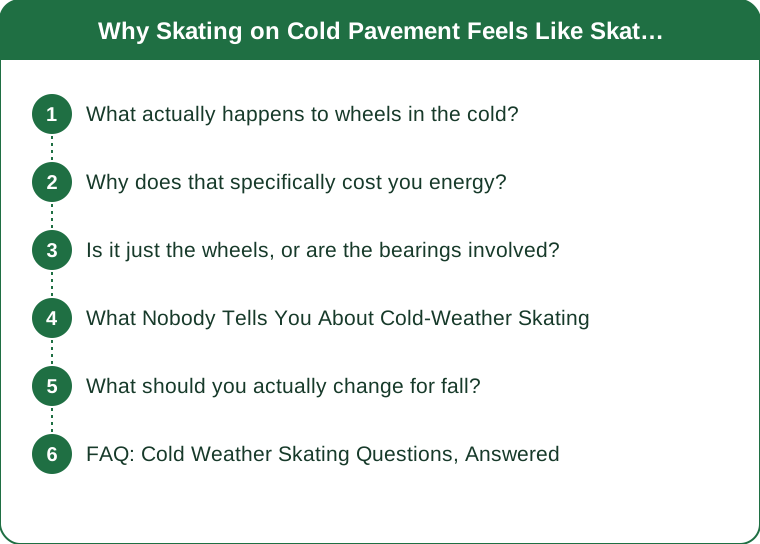
What actually happens to wheels in the cold?
Polyurethane is a thermoplastic elastomer, which means its stiffness is temperature-dependent in a way that’s genuinely significant over ordinary weather ranges.
As temperature falls, the polymer chains lose mobility and the material stiffens. A wheel rated at 78A durometer at 70°F behaves closer to 82A or 83A at 45°F. That’s not a subtle difference — it’s the gap between an outdoor wheel and an indoor rink wheel.
The consequence on rough asphalt is that the wheel stops deforming around surface texture and starts skipping over it. Each tiny impact is energy leaving your stride instead of being absorbed and returned.
That’s the glue feeling. It isn’t more friction in the bearings — it’s a wheel that has stopped conforming to the ground.
Why does that specifically cost you energy?
Rolling resistance on rough ground has two components: hysteresis (energy lost as the wheel deforms and rebounds) and impact losses (energy lost when the wheel strikes surface irregularities rather than rolling over them).
A soft wheel has higher hysteresis on glass-smooth surfaces, which is why rink wheels are hard. But on textured asphalt, a soft wheel’s ability to swallow bumps massively reduces impact losses, and that dominates.
Harden the wheel and you flip the balance. Less deformation, more impact. On coarse chip-seal, the difference between a 78A and an 85A wheel can feel like the difference between a paved path and a gravel one.
Add the fact that cold asphalt itself contracts and its surface texture becomes marginally sharper, and you have two effects compounding in the same direction.
Is it just the wheels, or are the bearings involved?
Bearings contribute, but far less than people assume.
Bearing grease does thicken in the cold, and that adds measurable drag. A thick, cold-stiff grease in a bearing packed for summer will feel noticeably slower on the first few minutes of a cold session.
But bearings warm up quickly with use — usually within the first quarter mile — and the drag drops back toward normal. If your session still feels heavy after two miles, it’s not the bearings.
One genuine bearing issue in fall: moisture. Damp leaves, morning dew, and puddles introduce water into bearings that then sits there. That produces real, permanent drag from corrosion, and it’s worth wiping bearings dry after any wet session.
The test that separates them: lift a skate and spin a wheel by hand. If it spins freely, your bearings are fine and the heaviness is the wheel-and-surface interaction.

What Nobody Tells You About Cold-Weather Skating
Your grip drops before your speed does. Harder wheels have less contact patch, which means less lateral grip. The first cold session is when people slide out on a turn they’ve taken a hundred times.
Wet leaves are more slippery than ice on polyurethane, and they hide the surface underneath. Autumn’s most underrated hazard isn’t cold, it’s leaf cover.
Your stopping distance grows. A T-stop or plow stop relies on controlled friction. Harder wheels give you less of it, so distances stretch — plan for roughly 25 to 30 percent more room.
Cold muscles change your stride before you notice. A shorter, choppier push in cold weather adds to the feeling of working harder, independent of equipment.
Ankles stiffen with cold boots. Leather and synthetic uppers both firm up below 50°F, which changes the flex you’ve calibrated to over the summer.
What should you actually change for fall?
Drop 4 to 6 durometer points for cold-weather outdoor skating. If you ride 78A in summer, a 74A or 72A wheel restores approximately the summer feel at 45°F. This is the single change that fixes it.
Keep a second set of wheels rather than swapping durometer back and forth twice a year — wheel changes take about ten minutes and having both sets mounted on separate frames or ready to swap makes it actually happen.
Warm up longer. Ten minutes of easy skating before any speed work, rather than the three minutes you got away with in July. Cold tendons and cold wheels both need it.
Wipe and dry bearings after any damp session, and re-lubricate every four to six weeks through fall rather than the summer interval.
Adjust expectations for the first mile. Wheels warm up from friction too, and grip improves measurably once they do. The first mile in cold weather is always the worst mile.
FAQ: Cold Weather Skating Questions, Answered
At what temperature does this start mattering?
Most people notice it below roughly 55°F, and it becomes obvious below 45°F. The exact threshold depends on your wheel’s starting durometer — a hard wheel crosses into unpleasant sooner than a soft one.
Will softer wheels wear out faster?
Yes, somewhat, particularly on coarse asphalt. But they wear more slowly in cold than the same wheel would in summer heat, so the seasonal swap is closer to a wash than it sounds.
Is indoor skating a better option in winter?
It’s a legitimate one, and rink surfaces reward the harder wheels you already own. Many outdoor skaters move indoors from November through March and keep their outdoor wheels soft for the shoulder seasons.
TL;DR:
- Polyurethane hardens as it cools; a 78A wheel behaves like 82A or 83A at 45°F.
- Harder wheels skip over asphalt texture instead of absorbing it, which is where your energy goes.
- Grip and stopping distance degrade before speed does — the first cold session is the risky one.
- Drop 4 to 6 durometer points for fall and keep a second set of wheels ready.
The heavy-legged feeling on a cold path is one of the few skating problems you can genuinely buy your way out of, and cheaply. A softer set of wheels costs less than a pair of shoes and gives you back the session you had in August — same path, same legs, different rubber.
Keep Reading
This article is for general informational and styling purposes only. Fit, sizing, and product availability may vary.