Why Roller-Skating Ankles Still Wobble Even With Laces Cranked All the Way Tight
Quick Answer: Tight laces provide external support but don’t build the ankle stabilizer muscle strength needed for genuine control, so wobble often persists in already-tight boots because the muscles responsible for real-time balance adjustments simply haven’t been trained yet — over-tightening can also restrict circulation and natural ankle flex without actually solving the underlying strength gap.
Cranking laces tighter treats roller-skating ankle wobble as a hardware problem, but for most beginners it’s a software problem — the muscles haven’t learned the job yet, no matter how locked-down the boot is.

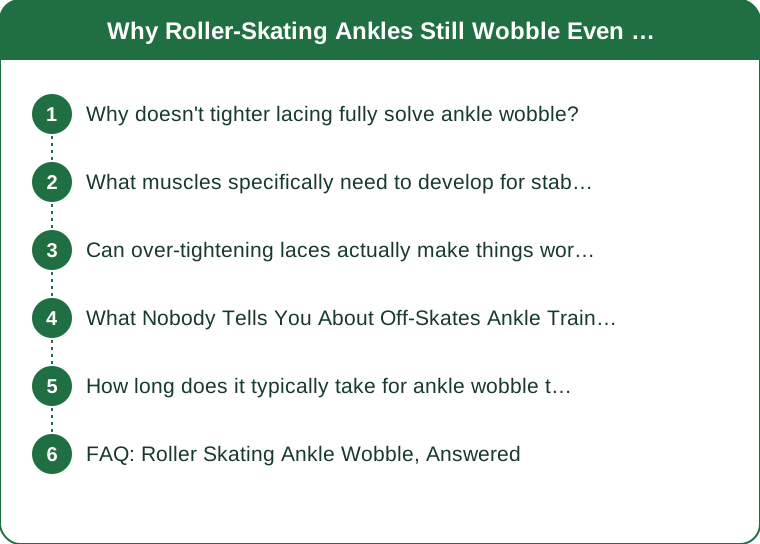
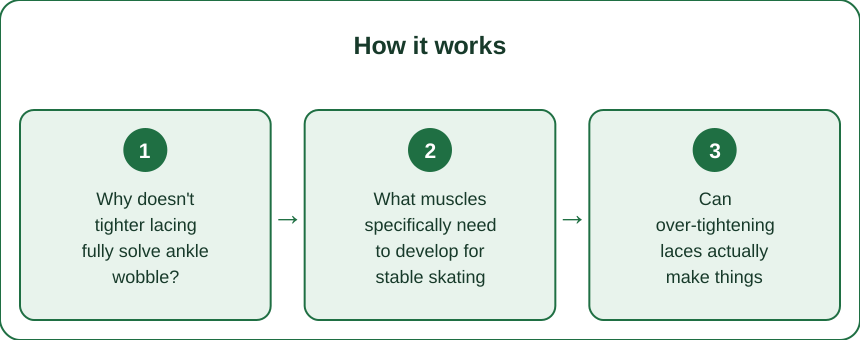
Why doesn’t tighter lacing fully solve ankle wobble?
Laces provide passive external support by limiting how far the ankle can physically move within the boot, but they don’t build the small stabilizer muscles around the ankle joint that are responsible for the constant, tiny real-time balance corrections skating actually requires — a boot can be tight enough to limit visible wobble while the underlying muscles remain weak, meaning the moment the skater pushes the boot’s support to its edge, instability shows up anyway.
What muscles specifically need to develop for stable skating ankles?
The peroneal muscles along the outer lower leg and the smaller intrinsic foot and ankle stabilizers are primarily responsible for lateral ankle control during skating, and these are different from the larger calf muscles that get more attention in general lower-leg training, meaning general leg strength doesn’t automatically transfer to the specific stability skating demands.
Can over-tightening laces actually make things worse?
Yes — laces tightened to the point of restricting blood circulation or completely eliminating the ankle’s natural slight flex can cause discomfort, numbness, and paradoxically make balance harder by removing the small amount of proprioceptive ankle movement the body uses to sense and adjust its position, meaning there’s a point past which tighter stops helping and starts hurting both comfort and actual control.

What Nobody Tells You About Off-Skates Ankle Training
Most roller skating beginner advice focuses entirely on on-skate practice time, but nobody tells you that specific off-skates ankle strengthening exercises — single-leg balance holds, resistance band ankle rotations, calf raises with a focus on control rather than speed — can meaningfully accelerate ankle stability development, since these exercises isolate and target the stabilizer muscles more directly than general skating practice alone, which mixes many skills at once.
How long does it typically take for ankle wobble to noticeably improve?
With consistent skating practice and some targeted off-skates ankle work, most beginners notice a meaningful reduction in wobble within four to eight weeks, though this varies with skating frequency and starting ankle strength, and the improvement tends to continue gradually beyond that initial window as the stabilizer muscles keep adapting.
FAQ: Roller Skating Ankle Wobble, Answered
Should laces be loosened if they’re currently maxed out and ankles still wobble?
Slightly loosening to a comfortable, non-circulation-restricting tightness while focusing on ankle strengthening exercises tends to be more productive than maintaining maximum tightness indefinitely.
Do higher-cut boots reduce the need for ankle strength training?
Higher-cut boots offer more passive support and can help beginners initially, but they don’t eliminate the value of building actual ankle strength, which continues to matter as skating skill and speed progress.
Are ankle wobble and actual ankle injuries connected?
Persistent significant wobble combined with any pain, rather than mild wobble alone, is worth paying attention to, since chronically weak stabilizers can contribute to a higher risk of ankle rolls or sprains during skating.
TL;DR:
- Tight laces provide passive support but don’t build the stabilizer muscles ankles actually need
- Peroneal and small ankle stabilizer muscles specifically control the balance skating requires
- Over-tightening laces can restrict circulation and remove helpful natural ankle flex
- Targeted off-skates ankle exercises accelerate stability improvement faster than skating practice alone
Ankle wobble on roller skates usually isn’t a lacing problem — it’s an undertrained muscle problem, and no amount of extra tightness substitutes for the strength those muscles still need to build.
Keep Reading
This article is for general informational and styling purposes only. Fit, sizing, and product availability may vary.