Practicing Falling Is the Fastest Way to Skate Faster
Quick Answer: Most skaters plateau because their body is bracing against a fall they have never experienced. Deliberately practicing controlled falls onto pads removes the unknown, which releases the tension in your knees and hips that was preventing a proper skating stance. It is the fastest confidence gain available and it takes about twenty minutes.
You can skate. You just cannot skate fast, and every time you try, something in your body pulls upright and puts the brakes on.
That something is not your technique. It is your nervous system protecting you from an outcome it has never actually seen.

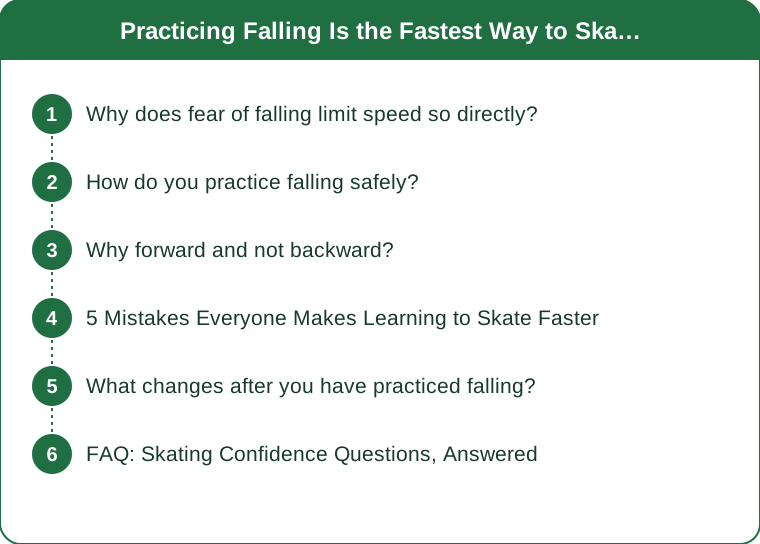
Why does fear of falling limit speed so directly?
Because the protective response is postural, and it produces the exact opposite of a good skating stance.
When your body anticipates a fall, it stiffens the legs, raises the center of mass, and pulls the torso upright. That is a sensible response for standing on ice. It is disastrous on skates, because skating requires a low, bent-knee, forward-weighted position — everything the protective response undoes.
So you end up in a feedback loop: fear produces a tall stiff stance, a tall stiff stance makes you genuinely less stable, and being less stable increases the fear.
This is why ‘just relax’ is useless advice and why some skaters spend years at the same speed despite plenty of practice. The technique instruction cannot land while the protective reflex is running.
Breaking the loop requires removing the unknown, and the only way to do that is to fall, in controlled conditions, on purpose.
How do you practice falling safely?
In a specific order, with proper protection, on a forgiving surface.
Gear first, and this is non-negotiable: knee pads, wrist guards, elbow pads, helmet. Wrist injuries are the most common skating injury by a wide margin, and wrist guards are the single highest-value item.
Surface: start on grass or carpet with skates on, then move to a smooth flat surface. Do not start on concrete.
Progression:
- Kneel down and stand up, stationary. No falling yet — just get comfortable putting weight on the knee pads and getting back up. Repeat ten times.
- Drop to knees from a slow roll. Very slow. Bend, drop forward onto the pads, let them take it, hands up not down.
- Drop to knees from a moderate roll. Same movement, more speed. This is the one that changes things.
- Practice the slide. From knees, let yourself slide forward rather than stopping dead. This is what pads are designed for.
The key technique in all of it: fall forward, onto the pads, with hands up rather than reaching down. Reaching out to catch yourself is what breaks wrists. Learning to land on the knees and forearms instead is the whole skill.
Why forward and not backward?
Because forward falls are controllable and backward falls are not, and you can strongly bias which one happens.
A forward fall lands on knee pads and forearms, in the direction you were already moving, with your eyes on where you are going. It is uncomfortable at worst.
A backward fall lands on your tailbone, your wrists if you reach, and potentially your head. It is the fall that produces real injuries, and it happens when your weight is behind your feet — which is exactly what the protective upright stance causes.
So the stance that feels safest is the one that makes the dangerous fall more likely. This is the central irony of learning to skate and it is worth stating clearly, because it reframes the whole practice.
Staying low with your weight slightly forward means that when you do lose balance, you go forward onto pads. That is the entire reason coaches insist on the bent-knee position, and it lands very differently once you have felt the difference yourself.

5 Mistakes Everyone Makes Learning to Skate Faster
1. Skipping pads because they look like beginner gear. Pads are what let you take the risks that produce progress. Experienced skaters at skateparks wear them for exactly this reason.
2. Practicing only on perfectly smooth surfaces. A slightly imperfect surface teaches your ankles to handle variation. Late summer outdoor paths, with their small cracks and grit, build more usable stability than a rink floor.
3. Looking at your feet. Where you look determines your weight distribution. Looking down pulls your head forward and, counterintuitively, your hips back. Eyes up, roughly 15-20 feet ahead.
4. Trying to go faster with the same stance. Speed requires a lower position, not a harder push. If your knee bend does not increase as you speed up, you are just pushing harder in an unstable posture.
5. Learning to stop after learning to go. Stopping should come first, and most people do it backwards. A reliable stop is what makes speed feel survivable, which is the other half of removing the fear.
What changes after you have practiced falling?
The change is usually immediate and larger than people expect.
What skaters typically report after one deliberate falling session:
- Deeper knee bend without having to think about it. The protective reflex releases and the stance comes naturally.
- Willingness to lean forward. Forward weight is the single biggest speed unlock and it is exactly what fear prevents.
- Less fatigue. Skating tense is enormously more tiring than skating relaxed. Sessions get longer.
- Faster learning of everything else. Crossovers, turns, and backward skating all become accessible once the baseline fear is handled.
The effect does fade somewhat with time away from skating, which is why repeating a short falling practice at the start of a season is worth doing. Five minutes of knee drops before a first outing after months off resets it quickly.
One honest note: this does not eliminate fear on genuinely dangerous terrain, nor should it. Steep hills, traffic, and rough surfaces warrant caution. What it removes is the background fear on ordinary flat ground, which is where the plateau lives.
FAQ: Skating Confidence Questions, Answered
Am I too old to be learning to fall?
Pads and progression matter more with age, not the willingness to practice. The main adjustments are more protective gear, a softer starting surface, and taking the progression more slowly — several short sessions rather than one long one. If you have osteoporosis, a recent injury, or joint replacements, check with your doctor first, since the risk calculation genuinely differs. This is general information, not medical advice.
How often should I practice falling?
Once properly, then briefly at the start of each session for the first few weeks — three or four knee drops as part of the warm-up. After that, at the start of each season or after any significant break. It is maintenance, not a permanent part of training.
Do I still need wrist guards once I have learned to fall forward?
Yes. The whole point is that falls you did not plan for are the ones that happen, and the reflexive hand-out response never fully disappears under surprise. Wrist guards are the item most experienced skaters keep wearing long after they have stopped wearing the rest.
TL;DR:
- Fear of falling produces a tall stiff stance, which is genuinely less stable — a self-reinforcing loop.
- Deliberate falling practice removes the unknown and releases the protective reflex, usually in one session.
- Full pads and wrist guards first; progress from grass to smooth surface, kneeling to slow roll to moderate roll.
- Fall forward onto pads with hands up — reaching down is what breaks wrists, and an upright stance causes backward falls.
- Learn to stop before learning to go fast; a reliable stop is the other half of removing fear.
The thing that makes this worth twenty minutes: nearly every other skating skill is gated behind it. You can practice crossovers for a month and improve slowly, or you can spend one session finding out that falling is survivable and discover that your knees bend properly for the first time. Most people are surprised by how quickly the plateau moves.
Keep Reading
This article is for general informational and styling purposes only. Fit, sizing, and product availability may vary.