Why Outdoor Skating in Fall Is a Different Skill Than Summer Skating
Quick Answer: Cold pavement reduces wheel grip because urethane stiffens below about 60°F, wet leaves are among the most slippery surfaces you’ll encounter, and low sun makes surface hazards genuinely hard to see. Softer wheels, wider stance, and a substantially longer stopping margin cover most of it.
The path you’ve skated all summer feels different in October. It isn’t confidence — the surface, the wheels, and the light have all changed at once.

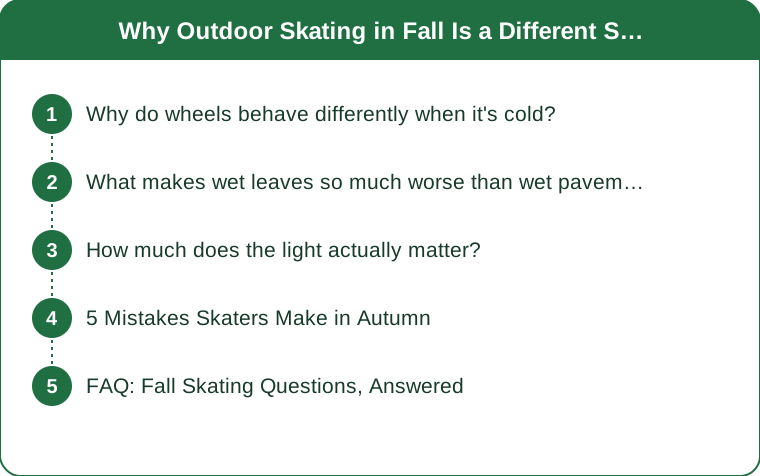
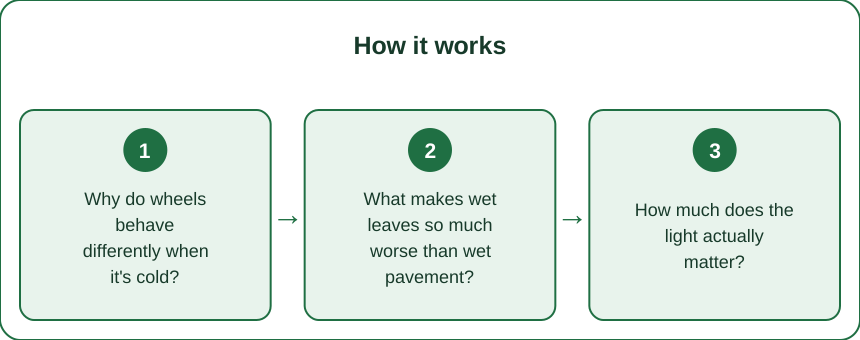
Why do wheels behave differently when it’s cold?
Because urethane is temperature-sensitive, and the change is significant.
Below roughly 60°F, urethane stiffens. A wheel rated at 78A durometer behaves closer to an 82A on a cold morning — noticeably harder, with less deformation at the contact patch.
Less deformation means less grip. A softer wheel grips by conforming slightly to surface texture. A stiffened wheel rides on top of it, which reduces traction, particularly in turns and under braking.
Roll increases, control decreases. Cold wheels roll faster and further, which feels good on a straight and considerably less good when you want to stop or turn.
The practical response: if you skate through autumn regularly, a softer wheel set is worth having. Dropping about 4 points of durometer — say 78A to 74A — roughly compensates for the cold-weather stiffening and restores the grip you’re used to.
And warm them up. Five minutes of easy rolling before doing anything technical raises the wheel temperature meaningfully. Cold wheels straight out of a car are at their least grippy.
What makes wet leaves so much worse than wet pavement?
Two mechanisms, and together they produce one of the lowest-friction surfaces you’ll skate on.
Leaves separate the wheel from the ground entirely. You’re not gripping pavement with reduced friction — you’re rolling on a layer of vegetation with almost no friction at all. Wet leaves have been measured as comparable to ice in some conditions.
They hide what’s underneath. A leaf layer conceals cracks, drain grates, and puddles. Even a dry leaf drift is a visual blackout of the surface.
They collect in exactly the wrong places — the edges of paths, the insides of corners, and the bottoms of slopes, which are precisely where you’re turning or building speed.
The technique adjustment
Cross leaf patches in a straight line, upright, with no braking and no turning. Momentum carries you across; any lateral force finds the low friction immediately. Treat it exactly like ice: get across it before you do anything else.
Widen your stance slightly for the whole session. A wider base gives you meaningfully more recovery room when a wheel slips.

How much does the light actually matter?
More than people account for, and it’s a compounding factor rather than a standalone one.
Low sun angle produces long shadows and glare. Surface irregularities that were obvious under overhead summer light become invisible under a low autumn sun. A crack in shadow at 5pm is genuinely hard to see.
Daylight ends fast. Losing several minutes a week means the session you started in good light finishes in poor light, and people consistently misjudge this in the first weeks of the change.
Damp pavement reflects and glares. The combination of low sun and a damp path can produce enough glare to obscure the surface entirely for stretches.
Practical responses: skate familiar routes as light gets low, add reflective gear earlier in the season than feels necessary, and shift sessions earlier in the day rather than trying to extend them. A headlamp is more useful than most skaters expect — not to be seen, but to see the surface directly in front of your wheels.
5 Mistakes Skaters Make in Autumn
1. Keeping the summer wheel setup. The single most impactful change available, and the one most people never make. Softer wheels for cold months is standard practice among skaters who ride year-round.
2. Skating the same speed on a familiar route. Familiarity is the trap. Your usual pace on your usual path assumes summer grip and summer visibility.
3. Braking in the leaves rather than before them. Braking requires friction, and that’s exactly what a leaf patch doesn’t have. Scrub speed before you reach it, then coast across.
4. Not warming up the wheels. Five minutes of easy rolling changes the wheel’s behavior measurably. Going straight into a technical section on cold wheels is a common way to find out how much grip you’ve lost.
5. Skating in the same gear as summer. Cold hands lose fine control on wrist guards and on any protective adjustment. Gloves that fit under or over your guards make a real difference to control, not just comfort.
FAQ: Fall Skating Questions, Answered
What durometer should I use for cold weather?
Roughly 4 points softer than your summer setup. If you skate 78A in summer, 74A works well through autumn and winter outdoors.
Is it worth having a second set of wheels?
If you skate outdoors year-round, yes. Swapping wheels takes about ten minutes and it’s the highest-value seasonal change available.
How much longer does stopping take on cold pavement?
Enough to matter. Plan for meaningfully more distance than summer, and considerably more on damp surfaces or anything with leaf cover.
Can I skate on damp pavement safely?
On genuinely damp but leaf-free pavement, cautiously — reduce speed and avoid hard turns. Standing water and painted surfaces are where it becomes genuinely risky.
When should I stop skating outdoors for the season?
When frost becomes regular. Frost on pavement is effectively invisible and offers essentially no grip — it’s the point where the risk changes category rather than degree.
TL;DR:
- Urethane stiffens below about 60°F, reducing grip and lengthening stopping distance
- Drop roughly 4 durometer points for cold-weather wheels and warm them up for five minutes
- Wet leaves approach ice for friction and hide surface hazards — cross straight, upright, no braking
- Low autumn sun hides cracks and glares off damp pavement; shift sessions earlier
- Cold hands lose fine control, so gloves affect safety and not only comfort
The path didn’t change. The wheels got harder, the surface got slicker, and you can see less of it. All three have straightforward fixes, and the wheel swap is the biggest one.
Keep Reading
This article is for general informational and styling purposes only. Fit, sizing, and product availability may vary.