Why One Foot Learns to Skate Faster Than the Other
Quick Answer: You practise your good side more without realising it. Every free moment of coasting, every push, every turn you take by default goes to the dominant side, so the gap compounds session after session. There is also a genuine physiological asymmetry - most people have a clear stance leg and a clear push leg - but the practice imbalance is far larger than the physical one, and it is the part you can fix.
Here is why it happens and the specific drills that close it.

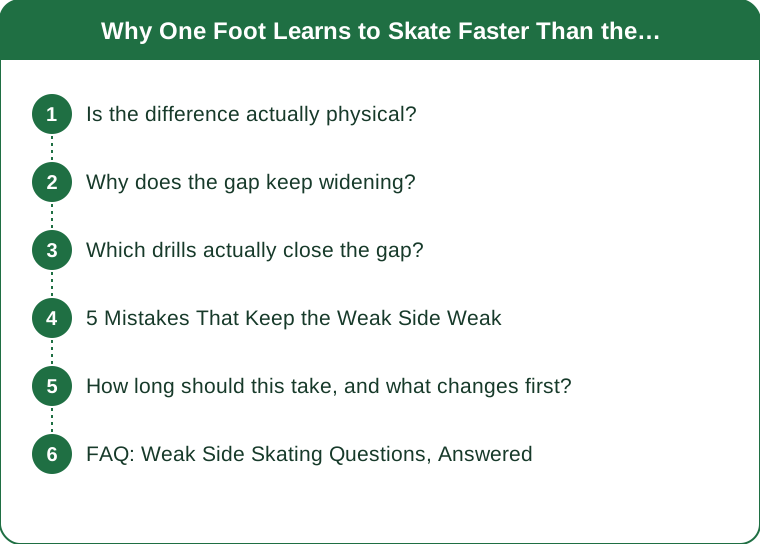
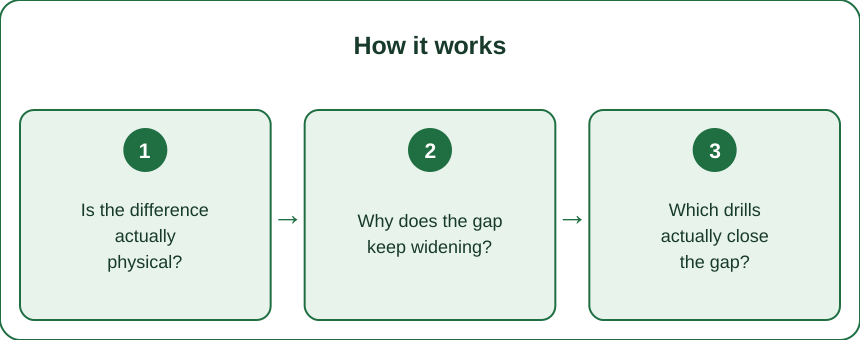
Is the difference actually physical?
Partly - but less than you think. Most people have a preferred stance foot, the one they would put forward if pushed from behind, and that foot is genuinely better at balancing. The other leg is usually the stronger pusher.
That baseline difference is small. What makes it look enormous on skates is that balance skill is highly trainable and highly specific. Small starting differences become large after a hundred hours of unequal practice.
Hip and ankle mobility differences add to it. Most people have a measurably more mobile side, and edge control depends heavily on ankle range. A stiff ankle limits how far you can lean before you run out of edge.
Vision and head position play a role people miss. Many people have a dominant eye and turn their head more comfortably one way, which affects which direction they can carve confidently. Turning away from your comfortable head-turn direction feels harder for a reason.
But the test settles it. Stand on one leg on the floor, no skates, eyes open, for 30 seconds each side. If both are similar, your asymmetry is a practice problem, not an anatomy problem - which is the case for most people.
Why does the gap keep widening?
Because unconscious practice all goes one way. Coasting between pushes, you stand on the comfortable foot. Over an hour session that is hundreds of extra repetitions on one side and almost none on the other.
Fear compounds it. The weak side feels unstable, so you spend less time there, so it stays unstable. The feedback loop is self-reinforcing and completely invisible while it is happening.
Turns default one direction. Most people carve one way naturally and steer the other way with a series of small corrections. Every session reinforces the good carve and never actually trains the other.
Falls teach the wrong lesson. One bad fall on the weak side produces weeks of protective avoidance, which sets that side back further than the fall itself did.
And progression hides it. As your overall skating improves, the good side improves faster, so your total ability rises while the gap grows. You feel like you are getting better, which is true, and you never address the asymmetry.
Which drills actually close the gap?
Count everything, and weight it toward the weak side. This is the whole method. Two-to-one in favour of the weak side until the gap closes, then one-to-one to maintain.
One-foot glides, timed. Glide on one foot as long as you can hold it. Do 5 attempts on the weak side to every 3 on the strong side, and record the time. This is the single most useful drill and progress is measurable within two weeks.
Scissors, weighted. Alternate feet forward while rolling. Hold the weak foot forward for a count of 5, the strong foot for a count of 2. This builds weak-side confidence at low speed with both feet still on the ground.
Slalom cones in your bad direction only. Set 8 cones about 1.5 metres apart, and carve only the direction you avoid, walking back to the start each time. Boring, and it works faster than anything else.
Weak-side-only pushes for one lap. Push exclusively with the strong leg so the weak leg has to be your entire stance leg. One lap is plenty at first - this is genuinely hard and that is the point.
And do 30 seconds of off-skate single-leg balance daily. Barefoot, eyes closed for the last 10 seconds if you can. Ankle stability transfers directly, and it costs nothing.

5 Mistakes That Keep the Weak Side Weak
1. Practising the weak side when you are already tired. Most people run their normal session then add weak-side work at the end. Balance is a coordination skill and it degrades with fatigue - do the weak side in the first 15 minutes, when your nervous system is fresh.
2. Only practising at speed. Speed provides gyroscopic stability that hides the deficit. Slow rolling is far harder and far more revealing, which is exactly why it trains more.
3. Looking down at the weak foot. Looking down shifts your weight forward and shortens your balance window. Eyes up and 5 to 10 metres ahead - the foot does better when you stop watching it.
4. Arms flapping for balance. Wild arm movement is a symptom of correcting too late. Arms out and quiet, at about waist height, forces the correction to happen at the ankle and hip where it belongs.
5. Not warming the ankles up. Cold ankles have less range and less proprioception, and the weak side suffers most. Two minutes of ankle circles and slow rolling before anything else changes the whole session.
And the bonus mistake: skating only on the same surface. Smooth indoor floors let a weak side hide. Varied surfaces expose it, which is uncomfortable and useful - just introduce them gradually and with full protective gear.
How long should this take, and what changes first?
Expect measurable change in three to four weeks with twice-weekly focused work. The first thing to improve is glide duration, because it is mostly a confidence and ankle-stability problem.
Turning in the weak direction takes longer - usually six to eight weeks - because it involves coordination between edge, head, and hip rather than a single balance skill.
The clearest sign of progress is unconscious. One day you will coast on the weak foot without deciding to. That is when it has actually transferred, rather than being a drill you can perform on request.
Track two numbers only. Weak-side glide time in seconds, and the ratio between sides. When the weak side reaches roughly 80% of the strong side, that is a practical target - perfect symmetry is not required and is rare even in experienced skaters.
Expect it to regress after a break. Come back from two weeks off and the weak side will have lost more than the strong side. Rebuild with the same two-to-one weighting and it returns quickly.
And note the seasonal shift. As mornings cool, surfaces get damp and grip changes, and a weak side that was coping in summer conditions will feel worse in autumn. Skate later in the day when the ground has dried, and add extra warm-up time - and always wear wrist guards, which prevent the most common skating injury by a wide margin.
FAQ: Weak Side Skating Questions, Answered
Is having a weak side normal?
Completely. Nearly every skater has one. The question is only whether the gap is narrowing or widening, and unmanaged it almost always widens.
Should I only practise my weak side?
No - a two-to-one ratio in its favour is better. Some strong-side work keeps your overall skating enjoyable and gives you a reference for what the movement should feel like.
Why does my weak side feel worse some days?
Fatigue, cold, and unfamiliar surfaces all hit the weak side disproportionately. It is also the first thing to go after a break of more than a week.
How long can a good one-foot glide be?
Recreational skaters usually work up to 10 to 20 seconds per foot on a smooth flat surface. The number matters less than the gap between sides.
Do off-skate exercises actually transfer?
Single-leg balance work transfers well because ankle stability and proprioception are the shared limiting factors. Thirty seconds a side daily is enough to notice.
Should I be wearing protective gear for drills?
Yes - especially for weak-side work, where you are deliberately operating at the edge of your control. Wrist guards in particular: wrist injuries are the most common skating injury by a large margin.
TL;DR:
- The gap is mostly practice, not anatomy. Every unconscious coast, push, and turn goes to your good side and compounds.
- Test it off skates: 30 seconds single-leg balance each side. Similar times means it is a practice problem you can fix.
- Weight drills two-to-one toward the weak side, and do them in the first 15 minutes when you are fresh.
- Slow rolling exposes and trains more than speed does - speed provides stability that hides the deficit.
- Eyes up, arms quiet and out. Looking down at the weak foot shortens your balance window.
- Expect glide times to improve in 3 to 4 weeks, weak-direction turns in 6 to 8. Target roughly 80% of your strong side.
Full protective gear for weak-side work - wrist guards especially. You are deliberately skating at the edge of your control.
Keep Reading
This article is for general informational and styling purposes only. Fit, sizing, and product availability may vary.