Why Learning to Stop Should Come Before Speed in Roller Skating
Quick Answer: Beginners who prioritize speed before mastering a reliable stop end up avoiding hills, crowds, and downhill sections out of fear — which actually slows overall progress. Drill the t-stop or plow stop until it’s automatic before building speed.
It feels natural to want to roll fast right away — that’s the fun part. But without a stop you actually trust, most beginners unconsciously skate more cautiously everywhere, which slows down real progress more than taking two extra sessions to nail a stop first.

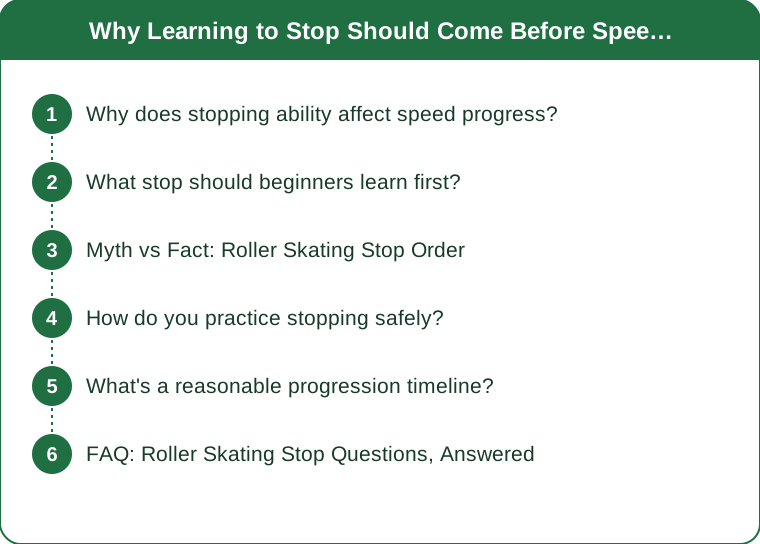
Why does stopping ability affect speed progress?
Confidence in your ability to stop directly determines how much speed you’re willing to attempt. Skaters who can’t stop reliably subconsciously brake with their whole body posture, dragging toes or grabbing railings — which is slower and less controlled than actually skating with a mastered stop technique in your toolkit.
What stop should beginners learn first?
The plow stop (heels together, toes out, squeezing wheels inward) is the most beginner-friendly first stop — it works at low-to-moderate speed and doesn’t require the balance the t-stop demands. Learn plow stop first, then add t-stop once you’re comfortable.
Myth vs Fact: Roller Skating Stop Order
Myth: You’ll naturally learn to stop once you’re comfortable rolling. Fact: Many skaters roll for months relying only on grabbing walls or falling on purpose — stopping is a distinct skill that needs deliberate practice, not something that happens automatically.
Myth: Toe stops are the main stopping method. Fact: Toe stops (dragging a toe brake) work but are less controlled at speed than a plow or t-stop — most instructors teach them as a backup, not the primary method.
Myth: Speed control while moving matters more than a full stop. Fact: Both matter, but a full stop you trust is what lets you attempt hills, crowded rinks, and higher speed with actual control rather than fear-based hesitation.

How do you practice stopping safely?
Start on a flat, empty surface at a slow roll — barely faster than walking pace — and practice the plow stop repeatedly until it’s automatic. Only increase your starting speed once the stop works reliably at the current speed, rather than practicing stops for the first time at a speed that feels exciting.
What’s a reasonable progression timeline?
Most beginners can get a reliable plow stop within 2-3 dedicated practice sessions of 20-30 minutes each. Rushing past this stage to chase speed typically means retrofitting stopping skills later, under more pressure and at higher speed — a harder way to learn the same skill.
FAQ: Roller Skating Stop Questions, Answered
Should I learn to fall safely too, not just stop?
Yes — knowing how to fall (tucking, rolling rather than catching yourself with a stiff arm) is a genuinely useful complementary skill, especially early on.
Do quad skates and inline skates stop differently?
Yes — technique differs somewhat between the two, so make sure you’re practicing the stop method appropriate to your specific skate type.
Is it too late to go back and drill stopping if I already skate fast?
Not at all — many experienced skaters retroactively improve their stopping technique and report feeling meaningfully more confident and in control afterward.
TL;DR:
- Skaters who can’t stop reliably unconsciously skate more cautiously everywhere, slowing overall progress
- Learn the plow stop first — it’s more beginner-friendly than the t-stop
- Practice stops at slow speed before increasing speed, not the other way around
- Most beginners master a reliable stop in 2-3 dedicated practice sessions
A trusted stop is what actually unlocks safe speed — not the other way around.
Keep Reading
This article is for general informational and styling purposes only. Fit, sizing, and product availability may vary.