Sharing the Path: Trail Etiquette for Skaters Among Walkers and Bikes
Quick Answer: Good trail etiquette for skaters means calling “on your left” early and audibly before passing, matching your speed to the crowd instead of your own pace, giving dogs and kids extra room, and stepping to the side to stop. Skaters are fast and quiet, which means they owe the trail the loudest courtesy.
The mixed-use trail is a small society: walkers, dogs on ambitious leashes, cyclists, strollers, and you — on eight wheels, faster than most and wider-turning than all of them. Skate etiquette keeps that society friendly, and not incidentally, it’s also what keeps trails legally open to skaters in the first place.

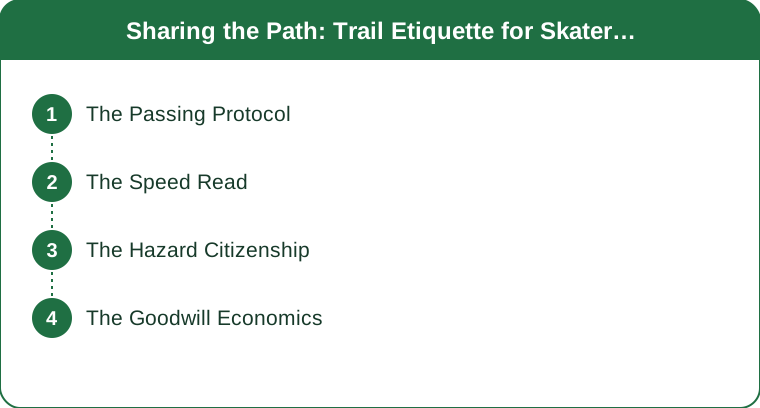
How Do I Pass Safely on a Shared Trail?
Call it out early: “on your left!” delivered well before you’re actually alongside someone, not shouted at the moment you pass. A call that lands right as you’re passing causes a startle-swerve, and that reflexive flinch is how most skater-pedestrian collisions actually happen.
Once you’ve called it, pass wide and at a slightly reduced speed, and toss out a quick “thank you” as you go. Give earbud-wearing walkers extra margin — they likely didn’t hear your call at all, so treat them as if they can’t hear anything behind them.
How Fast Should I Skate on a Crowded Trail?
Match the trail’s speed, not your own. A crowded Saturday morning path caps everyone’s pace — save the real speed for empty weekday mornings when there’s nobody to navigate around.
The sight-line rule is the practical test: never go faster than you can stop within the distance you can actually see. A blind curve with a stroller waiting just around it is exactly the scenario this rule exists for.

What Extra Care Do Dogs, Kids, and Stopped People Need?
- Pass on the dog owner’s side, not the dog’s — the leash itself is an invisible tripwire that extends further than you’d expect
- Give kids a wide buffer — children change direction unpredictably, more like weather than traffic
- Step off to the side before stopping — a skater standing mid-path is an obstacle for everyone else, so pull off the trail line completely before you pause
Skaters are fast and quiet, a combination that means they owe the trail the loudest courtesy of anyone using it.
Myth vs. Fact: Skating on Shared Trails
- Myth: If I’m going slow enough, I don’t need to call my pass. Fact: even a slow pass can startle someone who doesn’t hear you coming — the call matters regardless of your speed.
- Myth: Trail access for skaters is guaranteed and permanent. Fact: trail access is a reputation economy — enough friction between skaters and walkers has led to skating-banned signage appearing with remarkable speed in plenty of parks.
- Myth: Courtesy on the trail is just being nice, not strategic. Fact: every courteous pass functions as a small deposit in the access account for the whole skating community, whether you think of it that way or not.
Skate Trail Etiquette FAQ
What should I say when passing a walker on a trail?
“On your left” (or “on your right,” matching your actual side) called out early and clearly, well before you’re alongside them. The timing matters as much as the words — a late call causes the exact startle-reaction you’re trying to avoid.
How much space should I leave when passing a dog on a leash?
Pass on the owner’s side of the path, giving the dog and the full length of its leash a wide berth. Leashes can extend farther than expected and shift direction suddenly if the dog notices you.
Why does skater etiquette matter for trail access overall?
Because trail rules for skaters are often decided based on how much friction skaters cause with other users — a few bad interactions can lead park authorities to restrict or ban skating on a given path. Consistently courteous skating is effectively advocacy for keeping trails open.
What’s the safest way to handle a blind curve on a shared trail?
Slow down well before you can see around it, and never assume the path is clear just because it was a moment ago. The sight-line rule exists specifically for this situation — you should never be moving faster than you could stop within the distance you can actually see, and a blind curve is where that margin matters most.
Is it rude to skate past someone without saying anything if I’m going slowly?
Even at a slow speed, a silent pass can startle someone who didn’t hear you approaching, especially from behind. A quick “on your left” costs nothing and removes the surprise factor entirely, regardless of how much speed you’re actually carrying.
What should I do if a walker or cyclist doesn’t respond to my pass call?
Treat the lack of response as a sign they didn’t hear you and give extra space accordingly, rather than assuming they’re ignoring you on purpose. Earbuds, hearing differences, and simple distraction are all common reasons someone might not react, and widening your pass margin costs you almost nothing.
TL;DR:
- Call your pass early and audibly, never right as you’re passing
- Match your speed to the crowd, and never outrun your own sight line
- Give dogs, kids, and stopped people extra room and space
- Fast and quiet means skaters owe the trail extra courtesy
- Good etiquette isn’t just polite — it’s what keeps trails legally open to skaters
Keep Reading
This article is for general informational and styling purposes only. Fit, sizing, and product availability may vary.