Roller Skates Feel Wobblier Than Inline — Here's the Real Reason
Quick Answer: Quad skates feel wobblier because your four wheels form a wider, independent base than inline’s single line — the fix is a slight knee bend and hip-width stance, not tighter boots.
You strap in, push off, and your ankles start arguing with each other. Everyone assumes it’s the skates. It’s usually the stance.

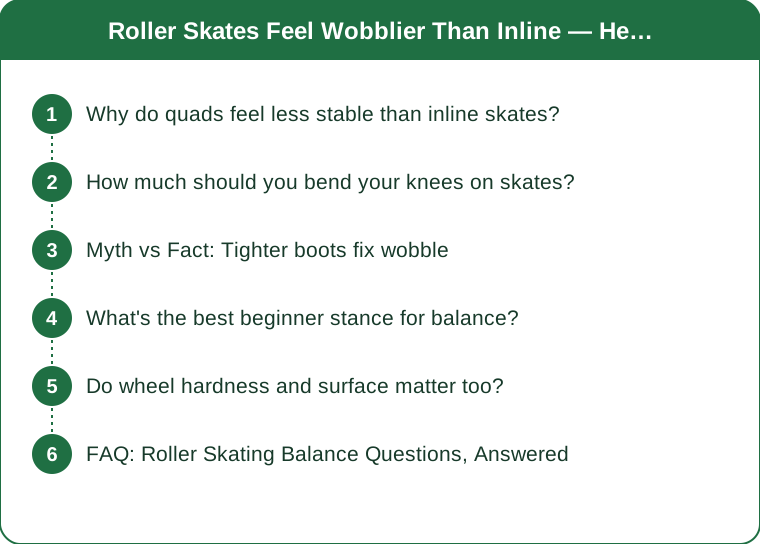
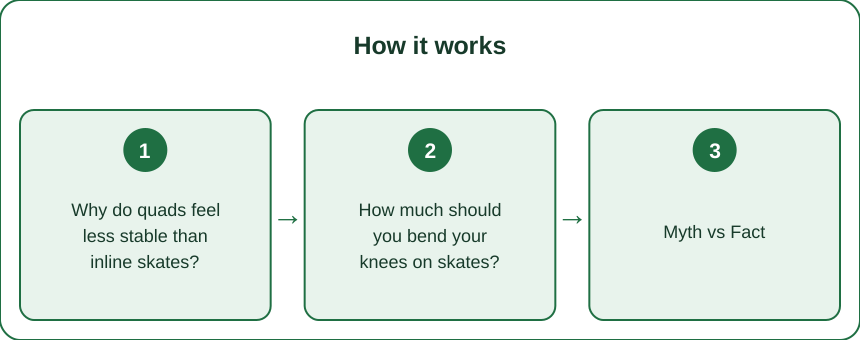
Why do quads feel less stable than inline skates?
Inline skates put all four wheels in one line, so your foot naturally tracks straight and side-to-side wobble gets absorbed by the frame. Quad skates split the wheels into two front and two back, which gives you a wider, more forgiving base for balance but makes side-to-side tipping feel more noticeable when your weight isn’t centered.
The result: quads are actually more stable for standing still, but they punish a narrow stance harder. If your feet are closer than hip-width apart, every shift in weight rocks you side to side instead of being absorbed.
How much should you bend your knees on skates?
A soft bend of roughly 15 to 20 degrees keeps your center of gravity low and lets your ankles and knees act as shock absorbers. Standing with locked, straight legs is the single biggest cause of the ‘wobble’ feeling beginners describe, because a stiff leg transmits every small correction straight up into your hips.
Practice this against a wall or railing first: bend the knees, feel your weight settle into your heels and mid-foot evenly, then let go for two seconds at a time.
Myth vs Fact: Tighter boots fix wobble
Myth: cranking your laces or buckles as tight as possible will stop the ankle roll. Fact: over-tightening restricts the ankle’s natural micro-adjustments, which makes falls more sudden because your foot can’t absorb small errors before they become big ones.
The better fix is a boot that’s snug through the heel and midfoot but allows a small amount of ankle flex — paired with the knee-bend habit above, this does more for stability than any amount of extra tightening.

What’s the best beginner stance for balance?
Stand with feet roughly hip-width apart, weight distributed evenly between both skates, and hands loosely out at your sides rather than jammed in pockets. Look ahead at where you’re going, not down at your wheels — looking down shifts your weight forward and makes the wobble worse.
Practice the ‘ready position’ standing still for 30 seconds at a time before you try rolling: this builds the muscle memory your ankles need before speed gets added to the equation.
Do wheel hardness and surface matter too?
Yes — softer wheels (78A–85A) grip better and forgive small technique errors, which is why most beginners start there, while harder wheels demand more precise balance but roll faster once you have it. Rough or uneven pavement also amplifies any stance problems, so practicing your first sessions on smooth, flat ground removes one variable while you’re still building the knee-bend habit.
FAQ: Roller Skating Balance Questions, Answered
Is roller skating harder to balance on than inline skates?
Not inherently — quads have a wider base and are often easier to stand still on, but they respond more to poor stance habits like straight legs or narrow feet.
How long does it take to feel stable on skates?
Most beginners feel noticeably steadier after 3 to 5 short practice sessions focused purely on stance, before ever trying to skate fast or far.
Should I hold onto something while learning?
Yes, a railing or a friend’s arm for the first few sessions is smart — it lets you isolate the knee-bend and stance work without the added stress of balancing unsupported.
TL;DR:
- Quad wobble usually comes from stance, not the skates themselves
- Bend your knees 15-20 degrees and keep feet hip-width apart
- Don’t over-tighten boots — some ankle flex is a feature, not a flaw
- Practice standing still before adding speed
Give your stance a few dedicated sessions before judging the skates — most people find the wobble disappears long before they expected it to.
Keep Reading
This article is for general informational and styling purposes only. Fit, sizing, and product availability may vary.